
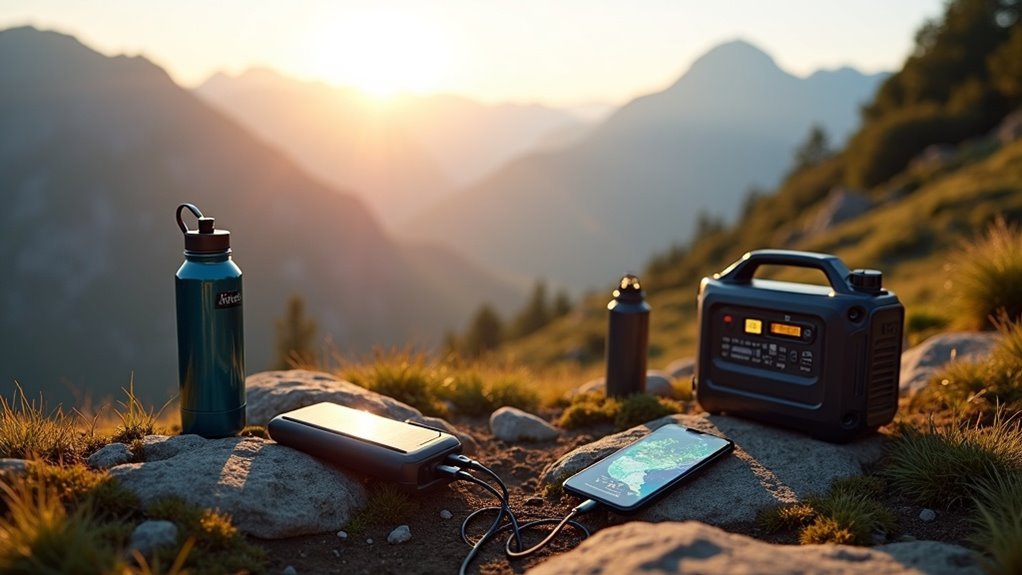
To keep your electronics charged during multi-day hiking trips, start by calculating your total power needs, including devices like your phone and headlamp. Use a 10,000 mAh power bank and plan to charge it with a solar panel. Position the solar charger in direct sunlight, especially between 11 AM and 4 PM, and avoid shading. Keep your external battery out of direct sunlight to prevent overheating. Want to know more tips on optimizing your charging strategy?
Key Takeaways
- Start with all devices fully charged and monitor battery levels to adjust usage throughout the hike.
- Utilize a 10,000 mAh power bank for efficient recharging of power-hungry devices.
- Position solar panels in direct sunlight during midday breaks to maximize charging efficiency.
- Keep batteries shaded during solar charging to prevent overheating and ensure optimal performance.
- Plan for resupply or recharge every 4 to 5 days to maintain device longevity.
Total Up All Your Power Needs
Before you head out on your hike, it’s essential to total up all your power needs to guarantee you stay connected and illuminated.
Start by evaluating the average daily usage of your devices. For instance, the iPhone 12 Mini depletes around 1,200 mAh daily, while the inReach Mini Messenger uses about 200 mAh.
Evaluate your device’s daily consumption, like the iPhone 12 Mini at 1,200 mAh and the inReach Mini at 200 mAh.
Don’t forget the Petzl CORE Headlamp, which consumes roughly 100 mAh.
With a 10,000 mAh external battery pack, you can recharge your devices, but plan for its depletion by day six.
Knowing these figures guarantees you’ve got the right battery pack to charge your essentials throughout your adventure.
Determine Your Charging Strategy
After tallying up your power needs, it’s time to craft a charging strategy that maximizes your devices’ longevity.
Start with all electronics fully charged on day one and consider these tips:
- Use a 10,000 mAh power bank for your most power-hungry device to guarantee you can recharge multiple times.
- Monitor battery levels regularly and adjust usage to extend power sources.
- Plan to resupply or recharge every 4 to 5 days when possible.
Tips on Optimal Solar Charger Usage
When you hit the trails, optimizing your solar charger usage can greatly extend your device’s battery life.
Position your solar panel in full sun, avoiding any shade that could diminish the charge rate by up to 50%. Take long breaks during midday, ideally between 11 AM and 4 PM, to maximize sunlight exposure for charging your devices.
Keep the solar panel attached to your pack to prevent loss and guarantee easy access whenever sunlight is available. Regularly check your surroundings for shadows that could obstruct sunlight, as maintaining efficiency is key for successful solar charging while hiking.
The Optimal Time of Day to Charge With a Solar Panel
The ideal time to charge your solar panel is during midday, specifically between 11 AM and 4 PM. This period offers the most direct sunlight, maximizing your charging rates.
Here are some tips to enhance your charging efficiency:
- Take longer breaks during midday to guarantee peak solar panel positioning.
- Avoid any shading by regularly checking for obstructions around your panel.
- Remember, even partial shading can drastically reduce charging rates.
Keep the Solar Panel Out of Shadows
How can you guarantee your solar panel stays productive while hiking? Keep it out of shadows to maximize its charging efficiency.
Even partial shading can drastically reduce power generation, with just 25% coverage potentially cutting your charge rate by half.
Position your solar panel in full sunlight, especially between 11 AM and 4 PM when the sun’s rays are strongest.
Regularly check for obstructions like trees or rocks that can cast shadows.
Keep External Battery Away From Direct Sunlight
To protect your external battery, always keep it away from direct sunlight.
Excess heat can slow down charging speeds and even cause permanent damage, so store it in your pack while using a solar panel.
Regularly monitor its temperature to guarantee ideal performance and longevity.
Heat Damage Prevention
While hiking, it’s essential to keep your external battery out of direct sunlight, as excessive heat can slow down charging speeds and even cause permanent damage.
To effectively implement heat damage prevention for your battery bank:
- Store your battery inside your backpack during solar charging to shield it from extreme temperatures.
- Monitor the temperature of your external battery; overheating can impair its function.
- Prioritize shading your battery while using solar chargers to guarantee it can charge faster and maintain its capacity.
Optimal Storage Locations
Finding the right storage location for your external battery during a hike is essential to maintain ideal charging conditions.
Keep your battery out of direct sunlight to prevent overheating, which can drastically slow its charging speed and lead to permanent damage. Best storage locations include inside your pack or under shaded areas while using solar panels. This protects the battery from extreme heat and enhances its overall efficiency.
Avoid placing it where sunlight can reach, especially during peak hours. By ensuring your external battery stays shaded, you’ll maximize its performance and longevity on your hiking adventure.
Temperature Monitoring Importance
Since high temperatures can considerably impact your external battery’s performance, it’s essential to monitor its temperature during hikes.
Keeping your battery out of direct sunlight can prevent it from overheating, which negatively affects charging performance and may lead to permanent damage.
Consider these tips:
- Store your external battery inside your pack while solar charging.
- Guarantee it’s shaded to maintain ideal temperature.
- Regularly check its temperature to prevent efficiency loss.