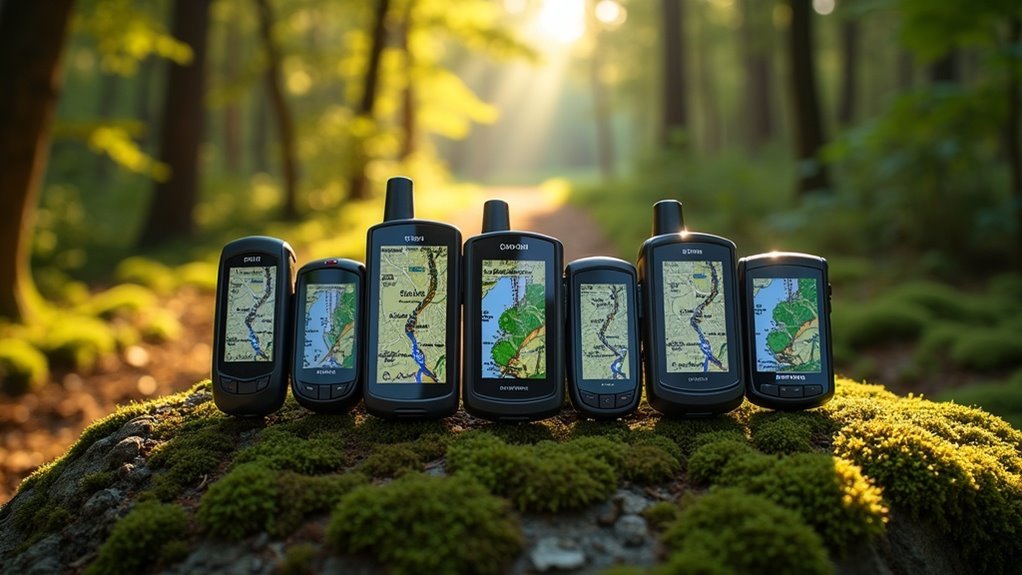
For 2025, consider the Garmin eTrex SE for its long battery life and rugged design. The inReach Mini 2 is great for safety with its SOS feature. If you’re looking for something compact, the NAVA F30 offers solid performance. Don’t forget about the versatile Tracki GPS Tracker for easy vehicle tracking, and gear up with the Atomic Bear Paracord Bracelet for emergency situations. With options tailored to various needs, there’s more to discover about the best hiking GPS devices.
Garmin eTrex SE GPS Handheld Navigator

If you’re an avid hiker seeking a reliable and compact GPS device, the Garmin eTrex SE GPS Handheld Navigator stands out with its impressive battery life of up to 168 hours in standard mode. This lightweight device features a 2.2” high-resolution display that’s easy to read in sunlight. It’s water-resistant, rated IPX7, making it perfect for tough outdoor conditions. With multi-GNSS support and Bluetooth connectivity, you can easily update software, plan trips, and access weather alerts. While some users mention interface issues, the overall performance and battery longevity make it an excellent choice for your hiking adventures.
Best For: The Garmin eTrex SE GPS Handheld Navigator is best for outdoor enthusiasts such as hikers and geocachers looking for a compact and durable navigation device.
Pros:
- Excellent battery life, lasting up to 168 hours in standard mode.
- Sunlight-readable 2.2” high-resolution display.
- Water-resistant design rated IPX7, suitable for various outdoor conditions.
Cons:
- Some users experience interface issues and difficulty with menu navigation.
- Stiff buttons may hinder ease of use.
- Limited detailed maps and memory for caching reported by users.
Tracki GPS Tracker for Vehicles and Assets

The Tracki GPS Tracker is the perfect choice for adventurers and families alike, offering real-time tracking for vehicles, kids, and valuable assets. This compact device, measuring just 1.8×1.6×0.7 inches and weighing only 1.26 ounces, is incredibly portable. With unlimited distance tracking via 4G LTE and international coverage, you can keep tabs on your belongings wherever you go. Enjoy up to five years of location history, live alerts, and a rechargeable battery lasting up to 60 days in saver mode. Plus, with 24/7 customer support and easy setup, you’ll feel secure and connected on all your adventures.
Best For: Families, adventurers, and anyone needing reliable real-time tracking for vehicles, kids, and valuable assets.
Pros:
- Compact and lightweight design makes it easy to carry and attach to various items.
- Unlimited distance tracking with 4G LTE and international coverage ensures you can locate your belongings anywhere.
- Comprehensive alerts and notifications keep you informed about movement, speed, and battery status.
Cons:
- Subscription is required for each device, adding an ongoing cost.
- Battery life can vary significantly depending on tracking mode, with shorter durations for real-time tracking.
- Compatibility limited to specific versions of Android and iOS, which may exclude some older devices.
Garmin 010-02256-00 eTrex 22x, Rugged Handheld GPS Navigator, Black/Navy

For outdoor enthusiasts seeking a reliable companion on their adventures, the Garmin 010-02256-00 eTrex 22x stands out with its rugged design and impressive mapping capabilities. Its 2.2” sunlight-readable color display guarantees you can easily navigate, even in bright conditions. Preloaded with Topo Active maps, you’ll find routable roads and trails perfect for cycling and hiking. Plus, the eTrex 22x supports both GPS and GLONASS satellite systems, enhancing tracking in challenging environments. With 8 GB of internal memory and a micro SD card slot, you’ll have ample space for downloads. Enjoy up to 25 hours of battery life on just 2 AA batteries.
Best For: Outdoor enthusiasts and adventurers looking for a durable and reliable GPS navigator for hiking and cycling.
Pros:
- Sunlight-readable color display for easy navigation in bright conditions.
- Preloaded Topo Active maps with routable roads and trails for enhanced outdoor exploration.
- Long battery life of up to 25 hours in GPS mode, ideal for extended trips.
Cons:
- Requires 2 AA batteries, which may not be convenient for all users.
- Limited internal memory of 8 GB may restrict the number of additional maps and data.
- Smaller screen size compared to some modern GPS devices, potentially making it less user-friendly for some.
Garmin inReach Mini 2 Satellite Communicator

Looking for a compact and reliable way to stay connected during your hiking adventures? The Garmin inReach Mini 2 Satellite Communicator is an excellent choice. Weighing just 3.49 ounces, it offers two-way messaging and global SOS capabilities with an active subscription. Its TracBack routing helps you navigate back, while the MapShare feature allows for location sharing. With a battery life of up to 14 days in tracking mode, you can hike with confidence. Although the small screen may challenge some users, its solid satellite connection and impressive features make it essential for outdoor safety and peace of mind.
Best For: Outdoor enthusiasts and hikers looking for a compact and reliable satellite communicator to stay connected in remote areas.
Pros:
- Compact and lightweight design makes it easy to carry on hikes.
- Impressive battery life of up to 14 days in tracking mode ensures long-lasting use.
- Solid satellite connection even in remote locations provides peace of mind for safety.
Cons:
- Small screen size may be challenging for users with poor eyesight.
- Some features require an active subscription, which may not be clearly communicated.
- Setup instructions are general, lacking specific guidance for emergency use.
Garmin eTrex SE GPS Handheld Navigator
If you’re an outdoor enthusiast seeking a reliable companion for your adventures, the Garmin eTrex SE GPS Handheld Navigator stands out with its impressive battery life—offering up to 1,800 hours in expedition mode. With a 2.2” high-resolution, sunlight-readable display, you’ll navigate with ease. The device supports multiple GNSS systems, ensuring accurate positioning wherever you roam. Its water-resistant design (IPX7) makes it tough for outdoor conditions. Plus, Bluetooth connectivity allows for software updates and smart notifications through the Garmin Explore app. While some users note interface issues, the eTrex SE is lightweight, compact, and perfect for hiking and geocaching.
Best For: Outdoor enthusiasts looking for a reliable and lightweight GPS navigator for hiking, kayaking, and geocaching.
Pros:
- Long battery life, with up to 1,800 hours in expedition mode.
- Sunlight-readable 2.2” high-resolution display for easy navigation.
- Water-resistant design (IPX7) suitable for various outdoor conditions.
Cons:
- Some users report issues with the interface and navigation menu.
- Stiff buttons can hinder ease of use.
- Limited detailed maps and customizable interface options.
Atomic Bear Paracord Bracelet (2 Pack) – Adjustable

The Atomic Bear Paracord Bracelet is an excellent choice for outdoor enthusiasts who value practicality and preparedness. This adjustable 2-pack bracelet fits sizes 8 to 10.5 inches, making it suitable for everyone. Each bracelet includes a fire starter, compass, emergency whistle, and 12 feet of military-grade paracord, perfect for hiking, camping, or fishing. The paracord can help with shelter or securing gear, while the fire starter is essential for warmth. Though the compass needs to be unfastened for accurate navigation, its lightweight design and overall utility make it a must-have for adventurers and families alike.
Best For: Outdoor enthusiasts, campers, backpackers, and families looking for practical emergency preparedness gear.
Pros:
- Includes essential survival tools like a fire starter, compass, and emergency whistle all in a convenient bracelet format.
- Adjustable size fits a wide range of wrist sizes (8-10.5 inches), making it suitable for men, women, and kids.
- Lightweight and compact, easy to carry and wear during outdoor activities.
Cons:
- Fire starter functionality may require practice to master, leading to mixed user experiences.
- Compass accuracy can be compromised when worn; needs to be removed for proper usage.
- Paracord cannot be reassembled once it has been used, limiting its reuse for multiple tasks.
NAVA F30 Handheld GPS Navigation Device

For casual hikers seeking a reliable navigation tool, the NAVA F30 Handheld GPS Device stands out with its rugged design and extensive support for GPS, GLONASS, and BEIDOU systems. With a preloaded worldwide basemap and compatibility for various map formats, you can explore confidently. Its compact size and lightweight nature make it easy to carry on your adventures. You’ll enjoy up to 20 hours of battery life using two AA batteries. However, be aware that some users reported difficulties with map downloads and language barriers, as the software is primarily in Chinese. It’s best for casual use, not advanced navigation.
Best For: Casual hikers and outdoor enthusiasts looking for a lightweight and reliable GPS navigation tool.
Pros:
- Rugged design with support for GPS, GLONASS, and BEIDOU systems for reliable navigation.
- Compact and lightweight, making it easy to carry on outdoor adventures.
- Long battery life of up to 20 hours on two AA batteries.
Cons:
- Users have reported challenges with map downloads and language barriers, as the software is primarily in Chinese.
- Lacks advanced features, making it more suitable for casual use rather than professional navigation.
- Customer ratings indicate mixed experiences, with an average score of only 3.0 out of 5 stars.
Factors to Consider When Choosing Hiking GPS Devices
When you’re choosing a hiking GPS device, you’ll want to think about several key factors. Consider the display size and quality, as well as the battery life, since you’ll need reliability on the trail. Don’t forget to check the weight, mapping features, and how durable and water-resistant the device is for your adventures.
Display Size and Quality
Choosing the right display size and quality for your hiking GPS device can greatly enhance your outdoor experience, especially as you navigate varied terrains. Display sizes typically range from 2.2 inches to larger options, affecting readability and navigation ease. Opt for a high-resolution screen of 240 x 320 pixels or above to guarantee visibility in different lighting conditions, including bright sunlight. Sunlight-readable screens are essential, keeping information clear even in direct light. Color displays improve map interpretation and waypoint visibility, offering better context than monochrome screens. Additionally, consider display technology, like transflective or LCD, as it can impact both battery life and visibility, influencing your hiking experience considerably. Choose wisely to guarantee your adventures are smooth and enjoyable.
Battery Life Duration
Battery life can make or break your hiking experience, especially on longer adventures. When choosing a hiking GPS device, consider how long you’ll be out. Many handheld models offer between 20 hours in standard mode to over 1,800 hours in expedition mode. If you plan on multi-day treks, opt for a device with longer battery life. Also, look for options that use standard AA batteries; they allow for easy replacements in the field when recharging isn’t feasible. Remember, the operational mode affects battery longevity—power-saving modes extend life but may sacrifice real-time tracking accuracy. Choose wisely based on your hiking frequency and needs to guarantee you stay on course without interruptions.
Weight and Portability
Weight and portability play crucial roles in your hiking experience, especially on long treks. When choosing a hiking GPS device, aim for options that weigh around 5-6 ounces for enhanced portability. Compact designs, roughly 4-5 inches long and about 2 inches wide, fit easily in your pocket or can be attached to your gear. While a heavier device might offer a larger battery or more features, it can lead to fatigue during multi-day hikes. The best handheld GPS strikes a balance between durability and functionality while remaining lightweight. Also, look for devices with versatile carrying options like clips or straps to make transport easier and keep your GPS accessible when you need it most.
Mapping Features Included
A quality hiking GPS device can greatly enhance your outdoor adventures, and mapping features are essential in making the right choice. Look for devices with preloaded topographic maps that display trails, roads, and key geographical features, which will aid in navigation and route planning. Multi-GNSS support—incorporating GPS, GLONASS, Galileo, and BeiDou—ensures better tracking accuracy in challenging environments. Pay attention to internal memory capacity for map downloads, as higher capacity allows for more detailed mapping options. Additionally, the ability to support extra mapping through micro SD cards offers flexibility to customize your experience. Features like paperless geocaching support can also enrich your outdoor experience by helping you manage geocache locations efficiently. Choose wisely for your next hike!
Durability and Water Resistance
When you’re out on the trails, the last thing you want to worry about is whether your GPS device can handle the elements. Look for a rugged design that can withstand harsh outdoor conditions, ensuring your device lasts through countless adventures. A water-resistant rating of at least IPX7 is essential, allowing it to be submerged in water up to 1 meter for 30 minutes without damage. Shock-resistant materials enhance durability, protecting against drops and impacts you might encounter. Also, consider battery life; a device should last several days without recharging, especially in remote areas. Finally, opt for lightweight construction to keep your gear manageable during long hikes. Your GPS should be tough, reliable, and portable—just like you.
Connectivity Options Available
Ruggedness and reliability are vital for any hiking GPS device, but connectivity options can greatly enhance your outdoor experience. Many devices now come with Bluetooth, letting you sync with mobile apps for trip planning and software updates. Multi-GNSS capabilities, including GPS, GLONASS, Galileo, BeiDou, and QZSS, improve tracking accuracy in challenging environments. Some models even offer automatic cache updates from geocaching services, giving you more navigation options. Plus, real-time alerts via push notifications, email, or SMS can be important for safety while hiking. Ascertain your chosen GPS device is compatible with various operating systems and web browsers for seamless integration with your favorite mapping and tracking apps. These features can truly elevate your hiking adventures.