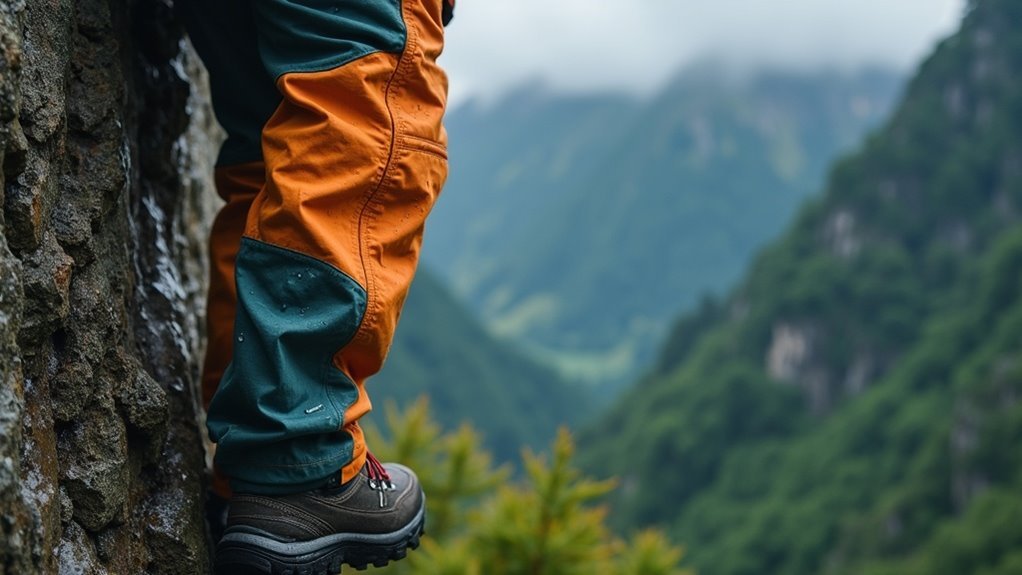

To use hiking poles for balance and efficiency, adjust them to a height that allows a 90-degree elbow angle when tips touch the ground. Maintain proper posture and sync your arm movements with the opposite leg for a natural rhythm. Shorten poles when climbing uphill and lengthen them for downhill descents to enhance stability and reduce strain on your knees. By mastering these techniques and adjusting to terrain, you can greatly improve your hiking experience and safety. There’s much more to discover!
Key Takeaways
- Adjust hiking poles to a 90-degree elbow angle for optimal balance and posture while walking.
- Shorten poles for uphill climbs and lengthen them for downhill descents to maintain stability.
- Synchronize arm movements with your opposite leg to create a natural walking rhythm.
- Use poles as a third point of support on uneven terrain to enhance safety and confidence.
- Engage your core muscles and maintain a relaxed grip to improve control and reduce fatigue.
Benefits of Using Hiking Poles
Using hiking poles can greatly enhance your outdoor experience, offering multiple benefits that improve both balance and efficiency.
These poles provide an extra point of contact with the ground, helping you navigate uneven terrain more safely. By distributing your body weight, they reduce strain on your knees and joints, especially during descents.
Hiking poles offer added stability on uneven terrain, reducing knee strain and enhancing safety during descents.
Additionally, engaging your arm muscles while using poles boosts your upper body strength and increases overall energy expenditure by 20-46%. This aids in maintaining proper posture and alignment, which is essential for those recovering from injuries.
Ultimately, incorporating hiking poles enhances safety and prevents falls on challenging trails.
Adjusting Your Hiking Poles
To maximize the benefits of hiking poles, proper adjustment is essential for comfort and efficiency on the trail. Here’s how to guarantee your poles are set correctly:
- Adjust pole height for a 90-degree elbow angle when the tip’s on the ground.
- Shorten poles by 5-10 cm for steep uphill climbs to enhance balance.
- Lengthen poles for downhill descents to improve stability and provide a braking effect.
- Use the top adjuster for quick adjustments as terrain changes.
- Regularly check locking mechanisms to maintain safety and avoid instability.
These adjustments greatly enhance your hiking experience while serving your needs on the trail.
Correct Techniques for Using Hiking Poles
To maximize the benefits of your hiking poles, it’s essential to adjust their height correctly and synchronize your arm movements with your legs.
As you tackle different terrains, remember to shorten your poles for uphill climbs and lengthen them for downhill descents, ensuring a smooth and efficient stride.
Practicing these techniques on flat ground will build your confidence and enhance your overall hiking experience.
Proper Pole Height Adjustment
Achieving the right pole height is essential for maximizing your hiking efficiency and balance. Proper adjustments guarantee you’re comfortable and stable on various terrains.
Here are some tips:
- Adjust poles to create a 90-degree angle with your elbows when tips touch the ground.
- Shorten poles by 5-10 cm for ascents to enhance your push angle.
- Lengthen poles for descents to act as natural brakes.
- Maintain proper posture on flat terrains with bent elbows at 90 degrees.
- Regularly check pole height for consistent support throughout the hike.
Synchronizing Arm and Leg
Once your poles are adjusted to the right height, the next step is synchronizing your arm and leg movements effectively. When using your poles, alternate their movement with the opposite leg to mimic a natural walking rhythm. This enhances your balance and stability, allowing you to navigate diverse terrains with ease.
Keep your elbows at a 90-degree angle for better leverage and reduced arm fatigue. Don’t hesitate to experiment with techniques like parallel leg movements or double pole usage, adjusting based on the terrain to optimize your stability and efficiency while hiking. Your body will thank you!
Techniques for Uphill Descent
As you tackle steep descents, employing the correct techniques with your hiking poles can greatly enhance your stability and control.
- Shorten your poles by 5-10 cm for better push angles.
- Plant poles ahead and angle them downward to brake.
- Use synchronized movement—opposite pole with opposite foot.
- Keep elbows slightly bent at a 90-degree angle.
- Maintain a gentle grip and engage your core for balance.
Terrain-Specific Adjustments
When traversing diverse terrains, adjusting your hiking poles can considerably enhance your balance and efficiency.
When ascending hills, shorten your poles and plant them slightly in front to optimize your push-off angle.
For descents, lengthen your poles and angle them downward to act as natural brakes, providing stability.
On uneven terrain, use your poles as a third point of support to help stabilize your body and prevent falls.
During water crossings, firmly plant your poles to test the ground’s stability.
In snowy conditions, gauge depth and stability with your poles to avoid slipping and guarantee a safer trek.
Common Mistakes to Avoid
While hiking poles can significantly enhance your stability and efficiency, several common mistakes can undermine their effectiveness.
To maximize your experience, be mindful of the following:
- Using incorrect pole length, leading to poor posture.
- Over-relying on poles, which can strain your wrists.
- Failing to synchronize pole movements with your opposite leg.
- Neglecting wrist straps, resulting in hand fatigue.
- Maintaining a tight grip instead of a relaxed hold.
Tips for Enhancing Balance and Stability
To enhance your balance and stability while hiking, start by adjusting your poles to create a comfortable 90-degree elbow angle.
Synchronizing your pole movements with your foot strikes won’t only improve your rhythm but also keep you steady on various terrains.
Proper Pole Adjustments
Adjusting your hiking poles correctly can greatly enhance your balance and stability on various terrains.
- Set your pole height so your elbows form a 90-degree angle at your side.
- Shorten the poles by 5-10 cm for uphill hikes to improve push angle.
- Lengthen the poles for downhill descents to reduce knee strain.
- Guarantee your hands sit comfortably on the grips, avoiding excessive strain.
- Regularly check and adjust your poles based on terrain changes.
With properly adjusted poles, you’ll enjoy a more efficient hike while supporting yourself and others on the trail.
Synchronizing Movement Techniques
With your hiking poles properly adjusted, you can now focus on synchronizing your movement techniques to further enhance your balance and stability on the trail.
Coordinate your pole movement with your opposite leg to create a natural rhythm that supports your stride. Keep your elbows at a 90-degree angle for ideal force generation without straining your arms.
Practice alternating your poles with foot strikes on flat terrain to build coordination before tackling tougher landscapes.
When ascending, shorten your poles and plant them ahead; for descents, lengthen them to act as brakes, providing stability and reducing joint impact.
Maintaining Your Hiking Poles
Maintaining your hiking poles is essential for ensuring their longevity and ideal performance on the trails. Here are some key practices to follow:
Regular maintenance of your hiking poles is crucial for their durability and optimal performance on the trails.
- Regularly clean your poles to prevent dirt buildup.
- Properly dry them after cleaning to avoid rust.
- Lubricate the locking mechanisms with silicone oil for smooth operation.
- Store your poles dry and clean, disassembling sections to reduce pressure on mechanisms.
- Use rubber caps on the tips while storing to protect both the poles and your gear.
Community Insights and Experiences
Many hikers have shared their experiences with using hiking poles, highlighting how these tools can transform your outdoor adventures. Over 90% of users report improved balance on uneven terrains, especially during ascents and descents.
Community discussions stress synchronizing pole movement with your foot strikes to enhance overall workout efficiency and prevent falls. Many recommend practicing on flat terrain to build confidence before tackling challenging hikes.
Hikers recovering from injuries find that poles provide essential support, reducing joint strain while ensuring better posture. Adjusting pole height based on terrain—shortening for uphill and lengthening for downhill—optimizes your balance and control.