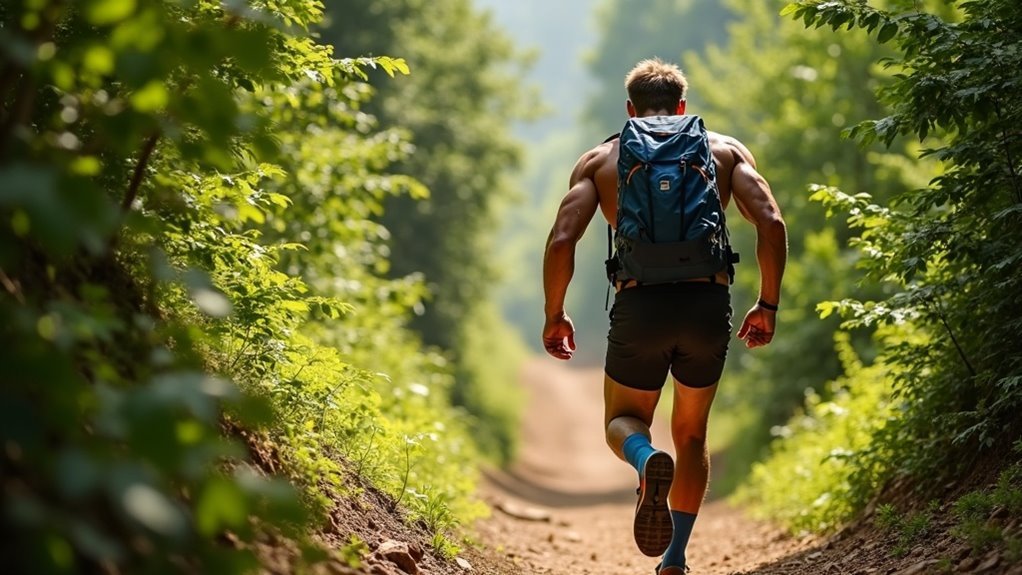
Uphill hiking works several key muscle groups, primarily your quadriceps, glutes, hamstrings, and calves. Your quadriceps kick in to extend your knees, while your glutes help with hip movement and stability. Hamstrings assist with leg bending, and strong calves support ankle stability and lift. Additionally, engaging your core muscles enhances balance and posture. This combination boosts your overall strength and endurance, making each trek easier. Discover more about how these muscles function and benefit you on the trail.
Key Takeaways
- Uphill hiking primarily engages the quadriceps for knee extension and overall leg power during ascents.
- Glutes facilitate hip extension and maintain proper back alignment, enhancing lower body strength.
- Hamstrings assist in bending the knee and extending the hip, working with quadriceps and glutes for balanced movement.
- Calf muscles provide ankle stability and support heel lift, crucial for maintaining balance on steep terrain.
- Core muscles stabilize the pelvis and spine, promoting balance and proper posture throughout the hike.
The Role of Quadriceps in Uphill Hiking
When you tackle an uphill hike, your quadriceps play an essential role in powering your ascent. These muscles in your legs, located in the front of your thighs, help extend your knees, pushing your body upward against gravity.
Strong quadriceps improve your balance and stability on uneven terrain, lowering the risk of falls. During ascents, they engage in eccentric contractions, controlling descents and preventing knee buckling.
To enhance your uphill hiking performance, incorporate strength training exercises like squats and lunges into your routine. Improved quadriceps strength leads to better endurance and less discomfort, allowing for longer, more enjoyable hikes.
Strengthening Glutes for Better Performance
To enhance your hiking performance, strengthening your glutes is essential, as these powerful muscles propel your body forward and upward on steep trails.
The gluteal muscles, particularly the gluteus maximus, are vital for effective hip movement, providing the strength and power needed when hiking uphill. Strong glutes support proper back alignment, reducing discomfort and fatigue, especially on challenging inclines.
Engaging these muscles boosts your lower body strength and stability, making it easier to navigate uneven terrain. Incorporate exercises like barbell step-ups and lunges into your routine for improved performance and injury prevention during your hiking adventures.
Hamstrings: Supporting Your Ascent
While strengthening your glutes lays a solid foundation for hiking performance, the hamstrings also play a significant role in your ascent. Located in the back of your thigh, your hamstrings help bend your knee and extend your hip, which is essential for climbing.
Engaging these muscles provides the necessary strength for uphill hikes, especially when walking on uneven terrain. They work alongside your quadriceps and glutes, ensuring balanced muscle function and reducing injury risk.
The Importance of Calf Muscles in Hiking
Calf muscles are fundamental to your hiking experience, especially during steep ascents. They assist in lifting your heel off the ground, providing the stability needed to navigate uneven terrains. When hiking uphill, strong calves help prevent injuries and maintain balance.
| Muscle | Role in Hiking |
|---|---|
| Gastrocnemius | Propels your body upward |
| Soleus | Stabilizes the ankle |
| Strength | Enhances endurance |
| Exercises | Calf raises improve strength |
Engaging Your Core for Stability
Engaging your core during hikes not only enhances your stability but also improves your overall efficiency on challenging terrains. A strong core supports proper posture, reducing back pain and discomfort during uphill hikes.
By activating your core muscles, you stabilize your pelvis and spine, which boosts your trekking performance.
- Improves balance on uneven surfaces
- Reduces energy expenditure for better endurance
- Allows for freer movement of limbs
- Helps maintain proper posture
- Decreases risk of injury
Incorporating core exercises like planks into your routine will greatly enhance your stability and performance on those demanding trails.
Additional Muscle Groups Activated During Hiking
When you hike, it’s not just your legs doing the work; your upper body plays a key role too.
Your arms and shoulders help with balance and momentum, while stabilizing muscles in your hips and ankles guarantee you stay steady on uneven ground.
Understanding these additional muscle groups can enhance your hiking experience and improve your overall performance on the trail.
Stabilizing Muscles Engagement
How do your muscles work together to keep you stable while hiking uphill? Your stabilizing muscles in the hips and core muscles engage to maintain balance and prevent injuries on rugged terrain.
These smaller muscles adapt to changes, ensuring effective movement while supporting your posture.
- Gluteus medius and minimus for hip stability
- Transverse abdominis and obliques for core strength
- Iliopsoas for leg lift efficiency
- Foot and ankle muscles for better proprioception
- Shock absorption to reduce injury risk
Upper Body Activation
Hiking isn’t just a workout for your legs; it also activates various upper body muscles that play an essential role in your stability and efficiency on the trail.
Using trekking poles engages your shoulders, arms, and back, especially the trapezius and rhomboids, which help stabilize your posture on steep climbs. As you pull your arms back, your biceps assist in propelling you forward.
Your deltoids, particularly the anterior deltoids, kick in to maintain balance while climbing. Plus, carrying a backpack engages your core and requires your upper body to stabilize and support the load, enhancing your overall hiking experience.
Preventing Injuries While Hiking Uphill
While tackling uphill trails can be exhilarating, it’s essential to take steps to prevent injuries that often accompany such challenging terrain.
Here are some key strategies to keep you safe and strong:
- Strengthen key muscles like quadriceps, glutes, and hamstrings.
- Incorporate balance and flexibility training for better stability.
- Gradually increase hike difficulty and distance to adapt your muscles.
- Perform proper warm-up and cool-down routines with dynamic and static stretches.
- Wear appropriate footwear with good traction and support.
Building Endurance and Strength for Future Treks
To tackle those challenging uphill trails, you need a solid foundation of strength and endurance.
Focus on strength training for your quads, glutes, and core, while also incorporating endurance-building techniques like hill repeats.
Strength Training Essentials
Building endurance and strength is essential for tackling the demands of future treks, especially when it comes to those challenging uphill trails.
Focusing on strength training not only prepares you for a heavy pack but also targets key hiking muscles. Here are some essentials to take into account:
- Barbell step-ups for quadriceps and glutes
- Front squats to enhance core stability
- Single-leg calf raises for improved balance
- Hill repeats to mimic uphill movements
- Lunges and squats for overall lower body strength
Endurance-Building Techniques
Strength training lays a solid foundation for hiking, but endurance is what’ll carry you through those longer, more challenging trails.
Incorporate hill repeats into your workouts, alternating intense uphill sprints with recovery periods for good cardio. Engage in stair climbing to target different muscle groups like your quadriceps, glutes, and calves, enhancing your overall endurance.
Functional training, including barbell step-ups and front squats, builds strength for steep inclines. Gradually increase the intensity and duration of your hikes, starting with easier trails.
Strengthening your core through planks and mountain climbers also boosts your balance and stability during prolonged uphill treks.
Recovery and Injury Prevention
While you may be keen to tackle the next challenging trail, prioritizing recovery and injury prevention is essential for long-term success in hiking.
Focus on these key aspects to enhance your performance:
- Stay hydrated before, during, and after hikes.
- Incorporate strength training like barbell step-ups for better muscle engagement.
- Stretch post-hike to aid recovery and prevent stiffness.
- Gradually increase hike difficulty to build endurance safely.
- Consider functional training and hill repeats to boost cardiovascular fitness.